

Best AR Companies for Virtual Try-On
Virtual try-on divides by what is being tried on, not by what the software costs. A face, a wrist, a foot and a pair of glasses are four different tracking problems, and a supplier that has solved one has not necessarily solved the others. Pick by category first, then by whether you want a hosted widget, an SDK or something you own.
In short:
- The category decides the shortlist. Beauty is face tracking, eyewear is face tracking plus optical fit, footwear and watches are limb tracking and apparel is body reconstruction.
- Two of the biggest names are now one company. WANNA sells fashion try-on under a logo that reads Now Part of Perfect, so a shortlist naming both is naming one supplier twice.
- Almost every published uplift figure lacks a method. Conversion and engagement percentages appear on every vendor site in this category with no stated measurement.
- One figure in this post carries its own error rate. Fittingbox publishes pupillary distance measurement within 1 mm for 7 out of 10 measurements, which is how a measured claim should read and which BestInXR's XR spec gap records as the only figure in the corpus that states its own error rate.
How this list was built
Virtual try-on is software that renders a product onto a live or captured image of the customer, tracked to their face, limb or body, so they can judge appearance or fit before buying. The definition excludes a 3D viewer, which shows the product rotating on its own, and a size recommender, which predicts fit without showing it. BestInXR's retail AR and VR guide sets out where try-on sits among the other retail purchases.
This list ranks four suppliers on four criteria: which tracking problems the supplier has actually shipped for, how the technology is delivered, what evidence it publishes in its own words and what the retailer holds at the end. Published conversion uplift is deliberately not a ranking factor, for the reason set out below.
Not a ranking factor: funding, patent count, app-store rankings or the number of logos on a homepage.
| Company | Tracking problems shipped | Delivery | Best for |
|---|---|---|---|
| Perfect Corp | Face, hair, skin and, through WANNA, feet, wrists and bags | Hosted platform and APIs | Beauty first, and fashion through the same vendor |
| Treeview | Commissioned experiences around the product | Built and transferred to the brand | A branded experience the retailer owns outright |
| Fittingbox | Eyewear, including optical fit and PD measurement | Hosted, e-commerce and in-store | Optical retail, online and in the store |
| Banuba | Face, plus web try-on for accessories | On-device SDK | A team building try-on inside its own product |
1. Perfect Corp
Perfect Corp covers more of this category than any other single supplier, and it recently covers more of it than most buyers realize. Its business site describes a YouCam platform of 28 APIs spanning makeup, skin, hair and accessories, and its homepage positions the company around AI beauty technology for beauty e-commerce.
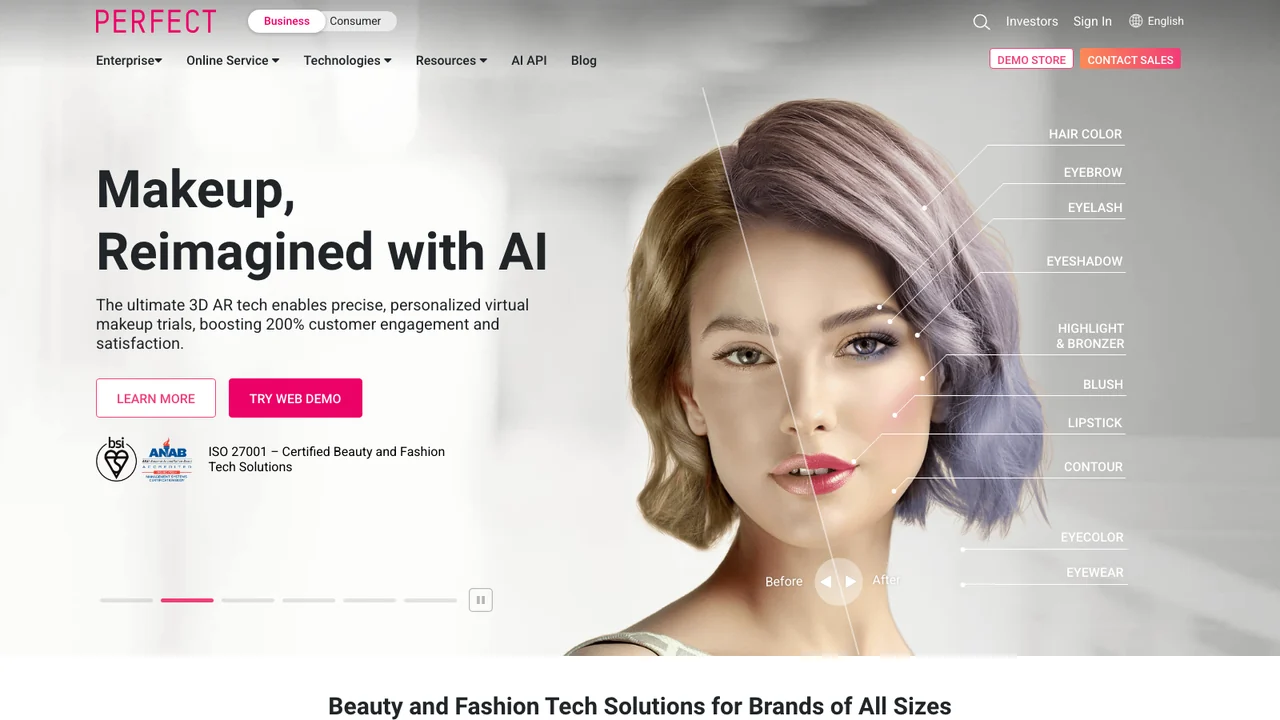
The reach beyond beauty comes from WANNA, whose site sells virtual try-on across footwear, bags, jewelry, watches, scarves and apparel, and names FARFETCH, Dolce & Gabbana, Valentino, Browns Fashion, IWC, Balenciaga, Diesel and Tod's among its brands. WANNA's own logo now reads Now Part of Perfect. That matters for a shortlist rather than for a product: face tracking and limb tracking are genuinely different engineering problems, and one company now sells both, so a comparison listing Perfect Corp and WANNA as competing options is comparing a vendor with itself.

Its published brand outcomes are extensive and should be read carefully. Perfect Corp attributes an 85% increase in sales to KOSÉ, a 14x uplift to Benefit Cosmetics, a 35% increase in basket size to Clinique and a 200% boost in customer engagement to M·A·C Cosmetics. WANNA publishes a 9% conversion increase, a 4% decrease in returns and a 6x conversion increase for Dolce & Gabbana. None of these state a measurement method, a comparison group or a period. They are claimed figures rather than measured ones, and the useful thing to do with them is ask the vendor what the control was. Best for beauty as the first category, with fashion available from the same supplier.
2. Treeview
Treeview is the supplier for the part of this category the widgets cannot reach, which is the experience around the product rather than the render on the customer's face. It is also the only entry here with published in-store work for a named beauty retailer.
Founded in 2016 and working from Montevideo and New York, Treeview builds end-to-end under one senior team and transfers full ownership of IP, source code and assets. Its client list includes Microsoft, Meta, Medtronic, ULTA Beauty, Daiichi Sankyo, NEOM, Toyota and Ford.

For ULTA Beauty it built an immersive in-store experience for the R.E.M. Beauty line, an interactive outer-space dreamscape delivered on Meta Quest, which Treeview records as enhancing product education, deepening brand connection and driving foot traffic to key Ulta Beauty locations. That is a different purchase from a try-on widget and it answers a different question. A try-on renders a product; a commissioned experience gives a customer a reason to care about it, and it is the route brands take when the launch has to be an event rather than a feature.
Ownership is the practical argument in retail specifically. Try-on delivered as a subscription stops when the contract does, and the assets and the experience usually go with it. A build transferred with its IP, source and assets remains the brand's after the campaign, which matters when the same 3D work has to serve the next season. Best for a branded retail experience the company needs to own outright rather than rent.
3. Fittingbox
Fittingbox is the specialist, and eyewear is the category where specialization earns the most. It presents itself as AR virtual try-on software for eyewear professionals, publishing 20 years of existence and 59 international patents.

Two things separate it from a general try-on vendor pointed at glasses. The first is the catalog: it publishes more than 195,000 frame references in 3D across more than 1,200 brands, which is the actual barrier in optical retail, because a try-on that does not contain the frame a customer wants is not a try-on. The second is Frame Removal, which lets a customer who already wears prescription glasses try frames without taking them off, and that is a problem specific to this category that nobody outside it has needed to solve. Named clients include Fielmann, Specsavers, JINS, Zenni, KITS, Eyerim and De Rigo.
Its published figures follow the same pattern as everyone else's, up to x3 conversion, 90% uplift at one client, 2x to 3x more sunglasses conversions at Fielmann, all without method. But one figure is different and is worth noticing: pupillary distance measurement within 1 mm for 7 out of 10 measurements. That is a measured claim with its error rate attached, and it is the only figure in this post that a reader can evaluate rather than trust. Best for optical retail, online and in the store.
4. Banuba
Banuba sells the components rather than the service, which suits an organization that has engineers and does not want a hosted dependency. Its Face AR SDK provides real-time, on-device face tracking, beauty and AR effects, and its TINT product is web-based virtual try-on for e-commerce, covering makeup, eyewear, jewelry and accessories along with contact lenses, rings, nail polish, hairstyles, wigs and hats.
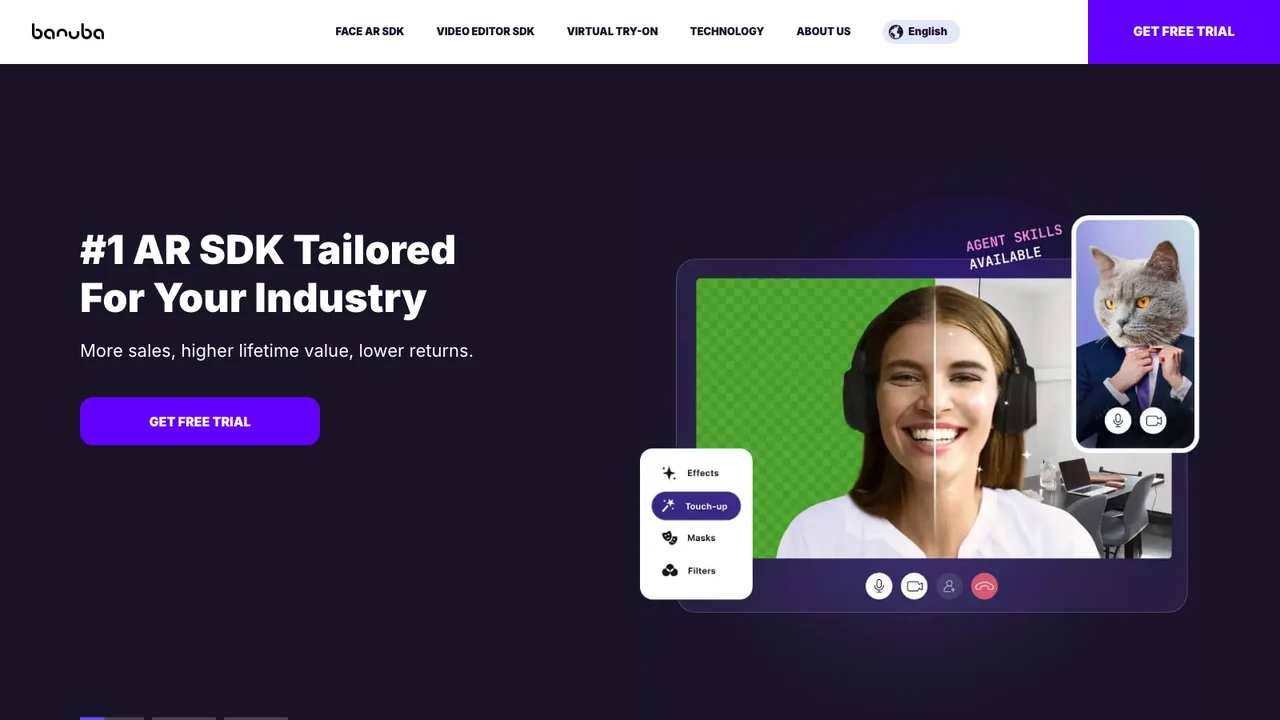
On-device is the phrase that decides whether this route is right. Tracking that runs on the customer's phone rather than on a server changes the privacy position, because the camera feed does not have to leave the device, and it changes the cost curve, because there is no per-render infrastructure to scale. It also puts the integration work on your side. Banuba publishes support for iOS, Android, Web, Flutter, React Native and Unity, and names Samsung, Logitech, RingCentral, Gucci and Schwarzkopf among its clients. It advertises integration in as little as 8 minutes, which is a claim about a sample project rather than about a production deployment, and should be read that way. Best for a team building try-on inside a product it already ships.
Who else was considered, and where each fits
WANNA is not ranked separately because it is not a separate company. Its own site carries Now Part of Perfect beside the logo, so it appears inside the Perfect Corp entry. Most current try-on lists still rank the two against each other.
Snap supplies real try-on capability through Camera Kit, described on its developer site as Snap's AR SDK that lets you bring Lenses into iOS, Android and web apps, alongside Lens Studio and Shopping Lenses. It is left out because it is a distribution and tooling route rather than a retail try-on supplier: the Lenses still have to be built by someone, and its AR site now leads with Specs hardware rather than with commerce.
Google's shopping try-on is a channel rather than a supplier. A brand cannot buy it, integrate it or own it, so it belongs in a channel strategy rather than in a vendor shortlist.
How to read the uplift figures in this category
Every supplier here publishes conversion and engagement improvements, the numbers are large and almost none of them can be checked. This is not a reason to dismiss the category. It is a reason to run the measurement yourself.
The figures share three specific gaps. There is no comparison group, so a shopper who chooses to open a try-on tool is being compared with the average shopper rather than with a matched one, and intent is doing part of the work attributed to the software. There is no period, so a launch spike and a sustained change are indistinguishable. And there is no attribution rule, so it is rarely clear whether a conversion counted because try-on was used at all or used on the product that was bought.
What to ask for instead is narrow and answerable. Ask for a holdout test, with try-on off for a proportion of traffic, run through a full merchandising cycle. Ask for return rate by category rather than overall, because try-on affects fit-driven returns and not others. And ask what happens to the 3D assets if you leave, because in most of this category the assets are the durable value and the tracking is the commodity. BestInXR's product visualization guide works through where those assets come from and what each route costs.
How to choose between these virtual try-on companies
Start with the category, because it is the constraint the sales conversation will skip. Eyewear is the clearest case: Fittingbox's frame catalog and optical measurement are the barrier, and a generalist that renders glasses onto a face has solved the easy half. Beauty is Perfect Corp's home ground and the deepest published brand list. Footwear, bags and watches are limb tracking, which is now also Perfect Corp through WANNA.
Then decide what you are buying. A hosted platform is the fastest route to live and the slowest route to independence. An SDK such as Banuba's puts the work and the control on your side and keeps the camera feed on the customer's device. A commissioned build from Treeview is the most expensive per launch and the only one that leaves you owning the experience and the assets.
Then ignore the uplift numbers on every site including the ones quoted above, and design the measurement before you sign. The vendor with the best figures is usually the one with the loosest definition of a conversion.
Frequently Asked Questions (FAQ)
1. What is virtual try-on?
It is software that renders a product onto a live or captured image of the customer, tracked to their face, limb or body, so they can judge appearance or fit before buying. A 3D viewer that shows the product on its own is not try-on, and neither is a size recommender.
2. Which companies provide virtual try-on technology?
Perfect Corp covers beauty and, through WANNA, fashion categories including footwear, bags and watches. Fittingbox specializes in eyewear. Banuba supplies on-device SDKs for teams building their own. Treeview builds commissioned retail experiences that the brand owns outright.
3. Is WANNA still an independent company?
No. Its own site shows Now Part of Perfect beside the WANNA logo, so a shortlist naming both Perfect Corp and WANNA is naming one supplier twice, which is one of the pairs in BestInXR's XR ownership map.
4. Do virtual try-on conversion figures mean anything?
Treat them as claims rather than measurements. Published figures in this category rarely state a comparison group, a period or an attribution rule, so the reliable route is a holdout test on your own traffic across a full merchandising cycle.
5. Can virtual try-on measure fit as well as appearance?
In eyewear, partly. Fittingbox publishes pupillary distance measurement within 1 mm for 7 out of 10 measurements, which is an appearance-plus-measurement claim with a stated error rate. In apparel, most products predict fit rather than measure it.