
Best VR Companies for Wind, Solar and Renewable Energy
Renewable energy buys XR for a reason the rest of the energy sector does not: a large share of the work happens before anything is built. Wind farms, solar arrays and hydrogen plants have to be financed, permitted and explained to people who cannot read an engineering drawing, and that is a visualization problem rather than a training one. This list ranks four suppliers across the pre-build and operational halves.
In short:
- Financing and permitting are the distinctive use case. Investors, government officials and landowners have to understand a project that does not exist, and a model they can walk is a more effective instrument than a document.
- The operational half is ordinary energy work: asset capture, remote inspection and procedure training, covered in BestInXR's energy guide.
- Capture windows are set by the asset, not the calendar. Offshore and remote sites impose access constraints tighter than any plant.
- Turbine and blade training is where behavior has to be modeled, because working at height on a moving asset is not a procedure a slideshow teaches.
How this list was built
This list ranks companies by four criteria: published work in renewables specifically rather than in energy generally, whether the deliverable serves pre-build communication or operations, what the buyer owns at handover and evidence of working inside the access and safety regimes these sites impose.
Published renewables work is weighted first because the sector is frequently claimed and rarely evidenced. Most XR suppliers list energy as a served industry; far fewer can name a wind, solar or hydrogen project. Naming one is checkable, and it is the difference between a supplier who has negotiated site access on an operating asset and one who has read about it.
Pricing is not a ranking factor, because none of the four publishes rates for this work. Headcount is not a ranking factor. Efficiency and downtime claims are not ranking factors, because no supplier publishes a method, and the variables outside the software dominate.
| Supplier | Published renewables work | Serves | Ownership |
|---|---|---|---|
| Treeview | Green hydrogen digital twin for Microsoft, deployed by Teyma | Pre-build communication and financing | Full IP, source and assets transferred |
| Luminous XR | ScanOps platform, offshore and energy assets | Operations and training | Platform license |
| Prevu3D | Reality capture of industrial and energy sites | Operations and as-built record | Platform license, recurring capture |
| LS Group | 3D and digital twin work across industry | Design, manufacturing and communication | Varies by engagement |
1. Treeview
Treeview publishes the most specific renewables project of any supplier in this list. Microsoft partnered with it to design and build an AI-enabled digital twin of a multi-billion-dollar green hydrogen renewable energy project, presenting an interactive model of energy production with predictive models of the site's future output.

What makes it relevant rather than merely impressive is the problem it was built for. Treeview records that the site development team could not effectively communicate complex data to investors, government officials and landowners during the feasibility phase, and that the mixed reality twin was deployed by Teyma, the hydrogen developer, as part of feasibility and fundraising. That is the renewables use case that distinguishes the sector: the audience for the model is financial and political rather than operational, and it is needed before construction rather than after. The build ran on Microsoft HoloLens 2, mobile and WebGL, which is the right delivery spread for an audience that will not all wear a headset.
Treeview was founded in 2016, works from Montevideo and New York, and publishes full transfer of IP, source code and assets. For a developer whose twin has to outlive a financing round and pass to an operator, that matters more than it does in most sectors. Best for pre-build visualization aimed at investors, regulators and landowners, and for a twin the developer needs to own outright.
2. Luminous XR
Luminous XR sells ScanOps, a platform whose stated purpose is turning real-world assets into operational advantage, with a live digital twin of operations behind it. Its published imagery and positioning lean offshore and heavy energy, which is the operational half of this sector.

For renewables the relevance is offshore wind, where the access problem is at its most severe. A technician visit to an offshore asset costs a vessel and a weather window, and anything that reduces the number of visits has a value the operator already tracks. The trade against a commissioned build is the usual one: a platform brings a working product and a recurring cost, and shapes your process to its model. Best for operating renewable assets where remote inspection displaces physical visits.
3. Prevu3D
Prevu3D turns reality capture into editable 3D environments and assumes recurring capture rather than a single commissioned model. In renewables that assumption is the right one for substations, converter stations and operations and maintenance bases, which change as plant is replaced.
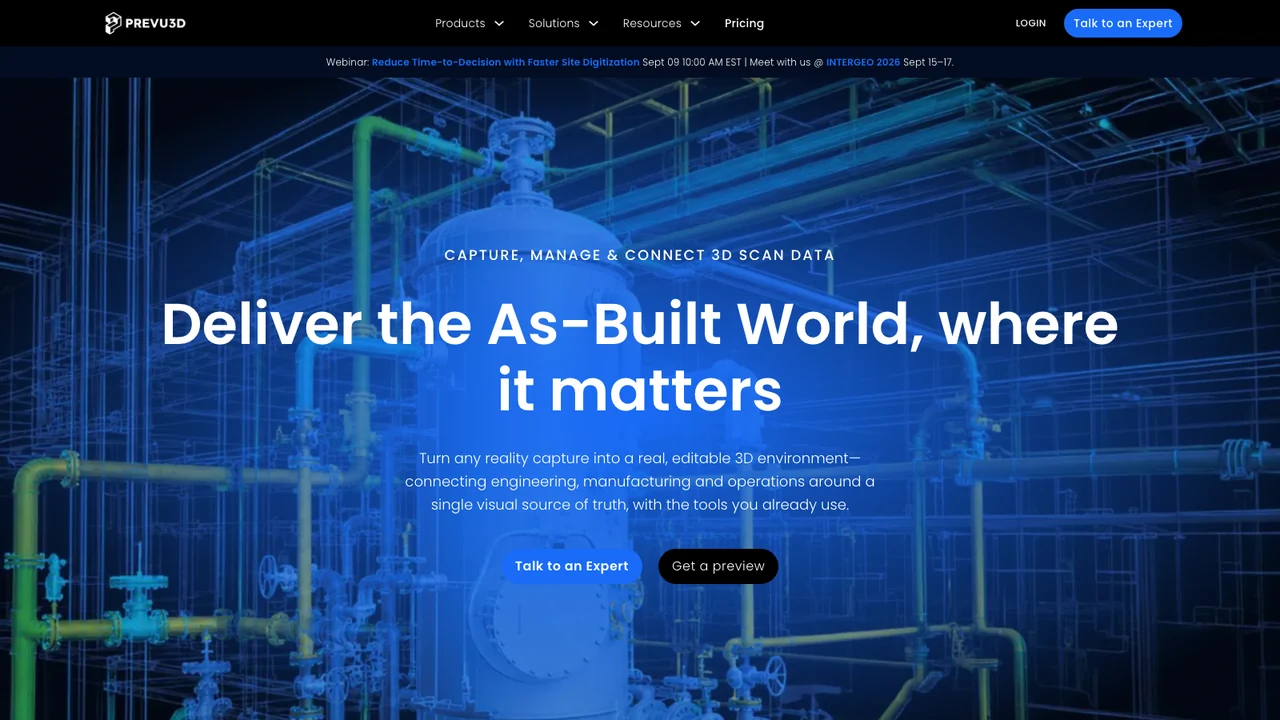
What it does not solve is the turbine itself. Capturing a nacelle 100 meters above ground on an operating asset is a different exercise from scanning a building, and the practical scope for most wind operators is the ground-level infrastructure plus whatever can be captured during scheduled maintenance. Establish which parts of the site are actually capturable before scoping. Best for as-built records of ground infrastructure that changes over an asset's life.
4. LS Group
LS Group works across design, manufacturing and commercial visualization through separate divisions, producing high-impact visuals, digital twins and immersive experiences. Its breadth is the offer and the caveat.
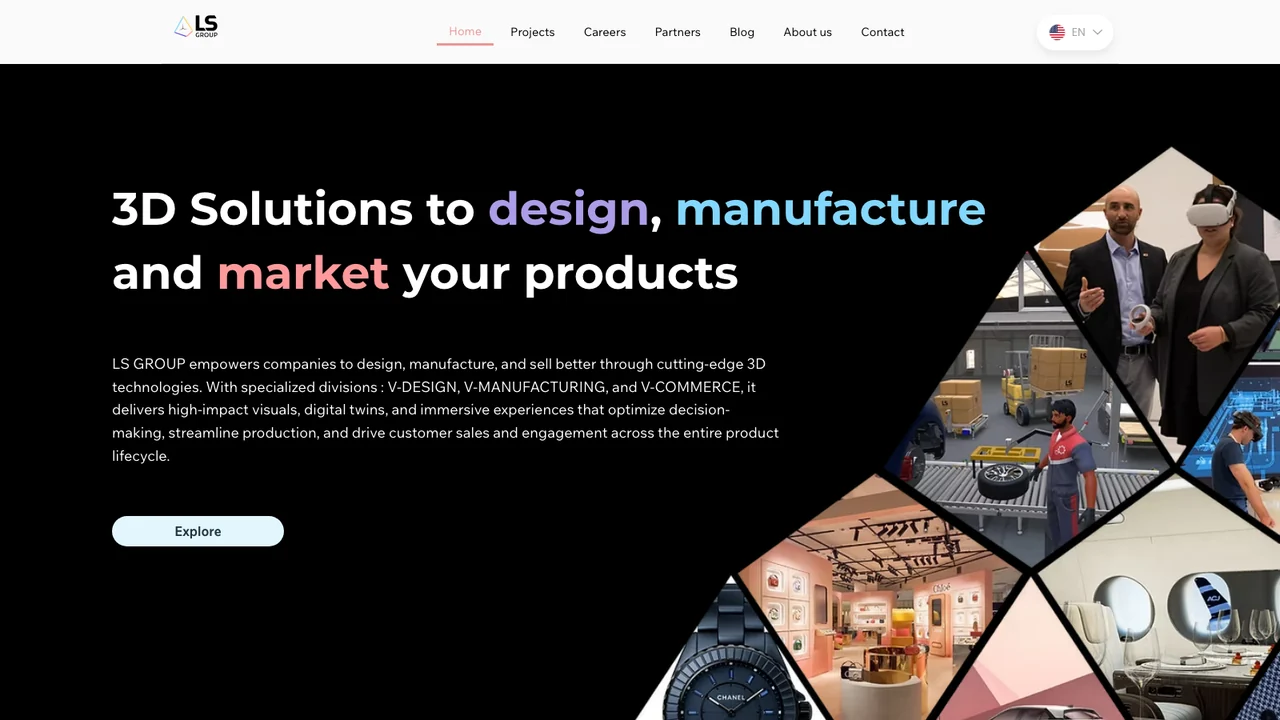
For a renewables manufacturer, as distinct from a developer or an operator, that combination fits: turbine and component makers need design review, manufacturing support and sales visualization from the same 3D source, which is a different requirement from either the financing model or the operational twin. It does not publish renewables projects by name, so a buyer should ask for sector-specific work rather than relying on the general portfolio. Best for renewable equipment manufacturers needing design, production and marketing visualization from one 3D pipeline.
What renewables projects have to account for
The audience is often not technical. Unlike the rest of energy XR, a significant share of renewables work is built for investors, regulators, planning authorities and communities. That changes the deliverable: it has to run on a laptop in a meeting room and a phone at a consultation, not only in a headset.
Access is set by the asset. Offshore sites impose vessel and weather constraints, and onshore wind imposes working-at-height rules. Neither resembles walking a process plant, and a supplier who has not worked under those regimes will underestimate the schedule.
Turbine work needs behavior modeled, not sequenced. For blade inspection and nacelle procedures the failure modes involve height, weather and moving equipment. BestInXR's simulation guide sets out why a procedure trainer and a simulation are different products, and this is a case where the distinction bites.
The twin outlives the financing round. A model built for feasibility is frequently the best record of the site that exists when the project passes to an operator. Whether the developer owns it decides whether that is an asset or a file nobody can open.
How to choose between these renewable energy companies
Establish which half of the project you are in. If the deliverable exists to secure money or permission, you are buying communication, and the criteria are clarity, delivery breadth and ownership. If it exists to run an asset, you are buying operations, and the criteria are capture accuracy, refresh and integration.
Then ask for a named renewables project rather than energy experience. The sector is widely claimed and specific evidence is thin, and a supplier who can name a wind, solar or hydrogen client has cleared a bar most have not.
Then settle ownership before the model is built. Feasibility-stage twins routinely become the operator's reference model by default, and the time to decide who holds the source is before the financing round rather than after it.
Frequently Asked Questions (FAQ)
1. What do renewable energy companies use VR for?
Two distinct things. Before construction, communicating a project to investors, regulators and landowners who cannot read engineering drawings. After construction, remote inspection, as-built records and procedure training on assets that are expensive or hazardous to visit.
2. Which companies build XR for renewable energy?
Treeview publishes a green hydrogen digital twin built with Microsoft and deployed by Teyma, Luminous XR and Prevu3D serve the operational half, and LS Group works with manufacturers across design and visualization.
3. Can you capture a wind turbine in 3D?
The ground infrastructure, readily. The nacelle and blades are a different exercise involving work at height on an operating asset, and for most operators practical capture is limited to what can be reached during scheduled maintenance.
4. Is a feasibility-stage digital twin worth keeping?
Frequently it is the most complete record of the site that exists when the project transfers to an operator. Whether it survives depends on who owns the source and whether anyone is funded to update it.
5. Does VR training work for offshore wind?
For procedure and hazard familiarisation, yes, and the case is strong because the alternative requires a vessel. For the physical handling elements, a simulation that models behavior teaches more than a scripted sequence, and some operators pair it with physical rigs.