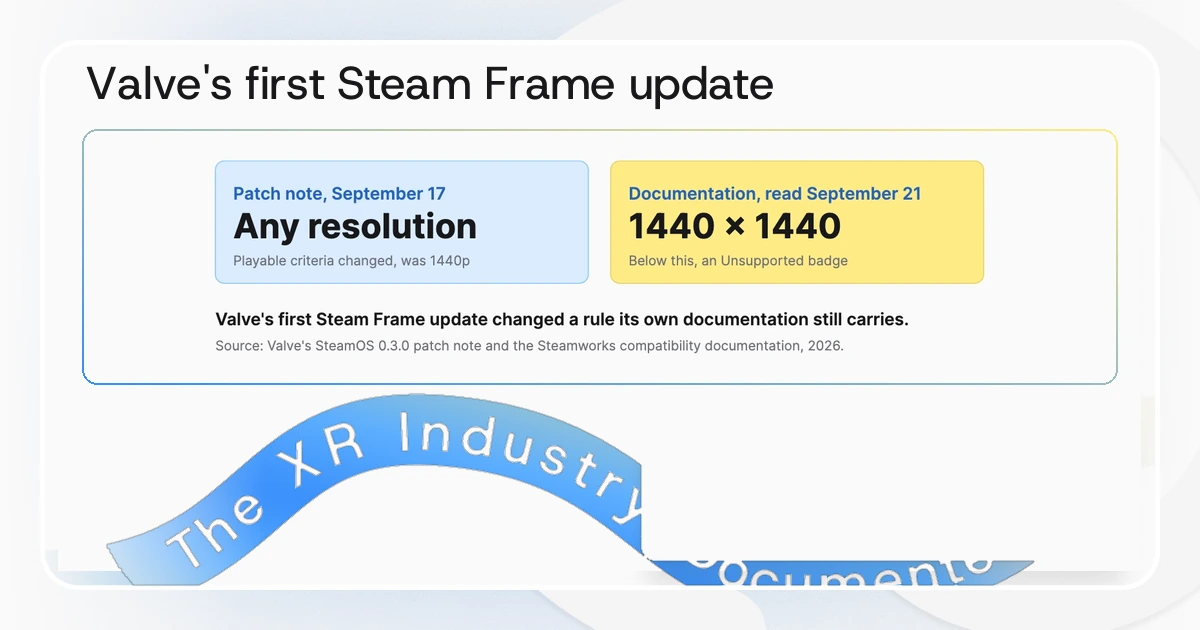
Valve released SteamOS 0.3.0 for Steam Frame on September 17, 2026, the only update posted to the headset's own news feed since it shipped. Owners get faster charging and better controller tracking. Developers get a changed rule: the patch note drops the resolution requirement for a Playable badge, while Valve's documentation still carries it.
In short:
- What shipped: SteamOS 0.3.0 for Steam Frame, which Valve says "has just been released for all users", with twelve changes listed under General, UX and Developer.
- What owners get: substantially faster charging while the unit is off or sleeping, improved controller tracking while haptics are active and a fix for a "garbled audio" microphone bug.
- What developers get: the Playable performance criteria now allow "any resolution", where Valve's note says the previous requirement was 1440p.
- What Valve has not reconciled: its Steamworks compatibility documentation still states that VR games below 1440x1440 "will appear with an Unsupported badge", checked September 21, 2026.
What SteamOS 0.3.0 changes
It is also the only entry on the product's feed. Steam Frame's event list carries one post, tagged Small Update / Patch Notes and dated September 17, read to the bottom of a fully scrolled page on September 21, 2026. The version number is 0.3.0, so earlier builds existed before the headset reached buyers.
Valve groups twelve changes into three sections. The General section lists substantially faster charging while the unit is off or sleeping, improved controller tracking while haptics are active, improved system stability under high load and a fix for a microphone bug Valve calls "garbled audio".
The UX section is mostly motion smoothing. Valve says a per-app Motion Smoothing setting called "Force Always-On" was being ignored and is now fixed, that motion smoothing behavior in Half-Life: Alyx is improved, that VR Settings gains a control for game dimming while the dashboard is visible and that the Play Area no longer shows its bounds automatically.
The Developer section carries four items. Three are performance work: Vulkan layer fixes for game compatibility, general system improvements and graphics improvements in Mesa. The fourth is the criteria change, and it is the only line in the update that changes what a shopper sees on a store page rather than what an owner feels on their head.
Why the Playable resolution line matters
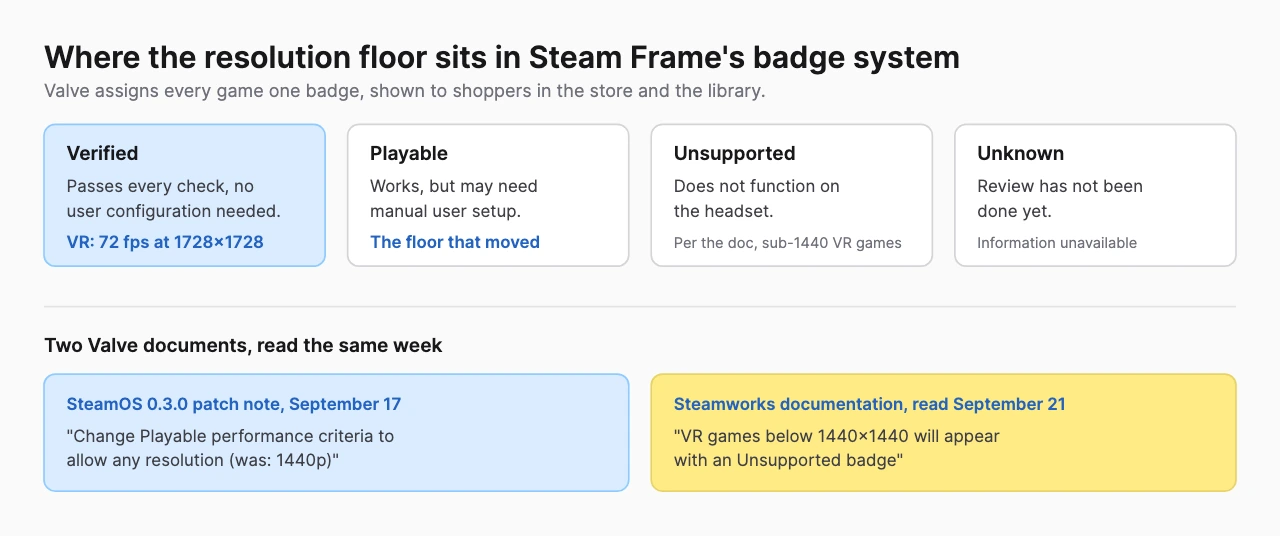
The line matters because Steam Frame badges are store furniture, not developer paperwork. Valve's compatibility review process assigns every game one of four badges, Verified, Playable, Unsupported or Unknown, and says that once results are published "users will see the appropriate compatibility badge when browsing games in both the store and the library".
Valve defines the middle two plainly. Playable means the game "functions on Frame, but may require manual work from the user", and Valve's own examples include "tweaking in-game settings to meet minimum performance requirements". Unsupported means the game "does not function on Frame". One of those is an invitation to try and the other is a wall.
The published performance bar sits under the Verified checklist. A VR title "must run at a minimum of 72 fps at 1728x1728 during normal play" and a 2D title needs 30 fps at 1280x720. Directly after that, the same document says VR games below 1440x1440 "will appear with an Unsupported badge". That sentence is the floor, and it is the thing the update says has moved.
Two Valve documents that no longer agree
Both statements are Valve's, and they cannot both describe how the system behaves today. The September 17 patch note says the Playable performance criteria were changed "to allow any resolution", with the previous requirement given as 1440p. The Steamworks page, read in full on September 21, 2026, still carries the sub-1440x1440 Unsupported rule.
Valve has not said which one is current. The patch note is dated and the documentation is not: the page carries no revision date anywhere, which is the same gap BestInXR recorded when reporting the Half-Life: Alyx port a week earlier. Read strictly, the shipped software is the more recent statement and the documentation has not caught up. BestInXR reports both and picks neither, because Valve has published no statement reconciling them.
The practical reading for a developer is narrow and worth stating anyway. A VR game rendering below 1440x1440 was, on the documentation as written, headed for a badge that tells customers it does not work. On the patch note as written, resolution alone no longer decides that.
What the update fixes for an owner
Charging is the fix most owners will feel first. Valve gives no figures, no before-and-after times and no battery capacity in the note, so "substantially faster" is the whole of the claim and BestInXR does not convert it into a number.
The controller tracking item is more specific about its conditions than most patch notes are. Valve scopes the improvement to tracking "while haptics are active", which names the interference rather than claiming tracking was broken generally.
The Alyx line connects this update to the one before it. Valve ported Half-Life: Alyx to Arm64 for standalone play on September 14, the day the headset shipped, and that port added foveated rendering and depth reprojection. Three days later Valve is tuning motion smoothing in the same title. The flagship is getting maintenance, not just a launch build.
What Valve has not published
Valve publishes no measurement anywhere in this update. There is no charging time, no tracking error figure, no frame rate and no count of how many titles the criteria change moves between badges.
There is also no explanation of the change itself. The patch note states the new criteria in nine words and gives no reasoning, so anything about why it changed would be invention. The Great on Frame list renders its games by script rather than serving them as text, so no badge counts were taken for this report and none are stated.
The Steam Frame product page is unchanged on price, at $1,059 for the 256GB model and $1,299 for 1TB, checked September 21, 2026.
Related reading. The Steam Frame launch report covers the price, the reservation queue and what is in the box. The Half-Life: Alyx Arm64 port explains the Standalone Verified program these badges belong to, and the XR headset comparison puts the Valve spec sheet beside Meta, Apple, Samsung and Pico.
Frequently Asked Questions (FAQ)
1. What is in the first Steam Frame update?
SteamOS 0.3.0, released September 17, 2026, lists twelve changes. The ones an owner notices are substantially faster charging while the unit is off or sleeping, improved controller tracking while haptics are active, a fix for a garbled audio microphone bug and several motion smoothing corrections.
2. Does Steam Frame still require 1440p for a Playable badge?
Valve's patch note says the Playable performance criteria were changed to allow any resolution, where the previous requirement was 1440p. Valve's Steamworks documentation still states that VR games below 1440x1440 appear with an Unsupported badge, checked September 21, 2026, and Valve has published nothing saying which statement is current.
3. What do the Steam Frame compatibility badges mean?
Valve assigns four. Verified means the game passes every compatibility check with no user configuration. Playable means it functions but may need manual work, such as tweaking in-game settings to meet performance requirements. Unsupported means it does not function on the headset, and Unknown means the review has not been done.
4. How much faster does Steam Frame charge after the update?
Valve does not say. The patch note describes charging while the unit is off or sleeping as "substantially faster" and publishes no times, no percentages and no battery capacity, so the size of the improvement is not documented.
5. Has Steam Frame changed price since launch?
No. Valve's product page lists $1,059 for the 256GB model and $1,299 for the 1TB model, the same prices the headset shipped at on September 14, 2026, checked September 21, 2026.