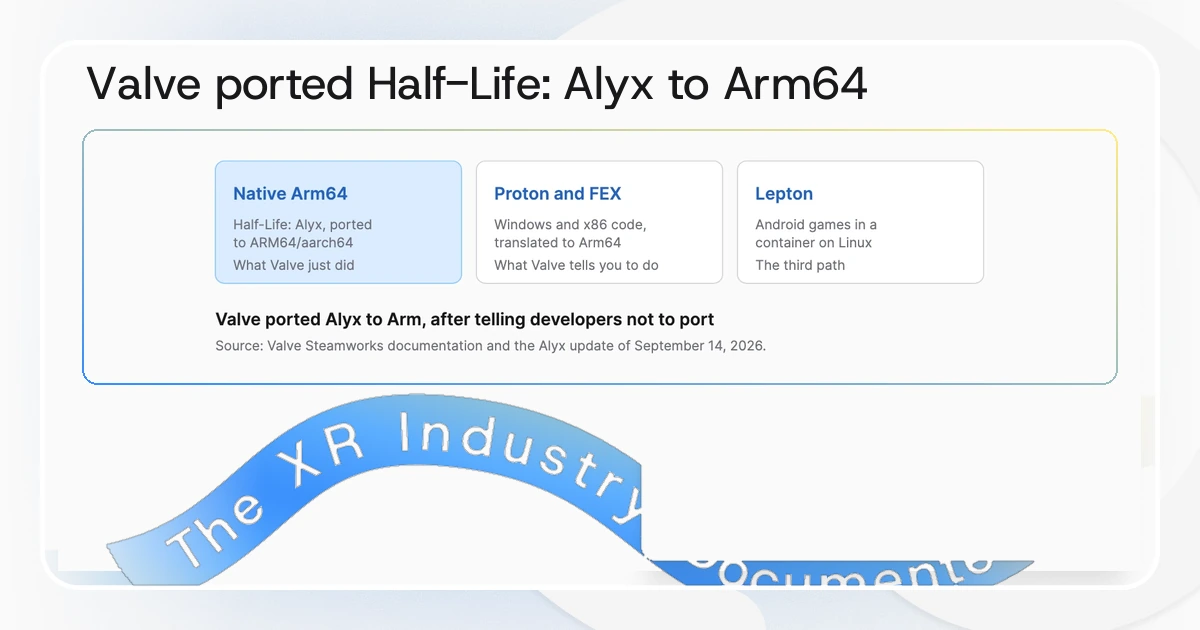
Valve has shipped a native Arm64 build of Half-Life: Alyx so the game runs on Steam Frame with nothing attached to it. The update adds foveated rendering and depth reprojection when the game runs standalone. It also cuts against Valve's own advice to developers, which is that most of them should not port at all.
In short:
- What changed: Valve ported Half-Life: Alyx to ARM64/aarch64 and added foveated rendering and depth reprojection for standalone play on Steam Frame, announced September 14, 2026.
- Why it is unusual: Valve's own developer documentation tells most studios to ship their existing Windows build and let Proton and FEX handle the rest, rather than maintaining a second one.
- What it costs: nothing extra. Every Steam Frame includes one copy of Alyx, redeemed on the device.
What Valve changed in Half-Life: Alyx
Valve published the update on the game's Steam news feed on September 14, 2026, under the headline Half-Life: Alyx Updated for Steam Frame. Valve describes it as "a major update that adds support for Steam Frame standalone gameplay".
Four of the changes are specific to the headset. Valve says it made rendering and performance optimizations for Steam Frame, "updating most of the engine without altering any of the content". It added foveated rendering when the game runs standalone. It added depth reprojection, which Valve says allows "smooth gameplay at lower framerates". And it ported the game to ARM64/aarch64.
That last line is the one that matters, because it is the only one that could not have been done any other way. The rest are optimizations. A port is a second build.
The same update carries seven general fixes that have nothing to do with the headset, including additional performance work on desktop PCs, the removal of one tick of latency on player hands and other simulated objects, and fixes for cross-platform cloud saves and missing subtitles on Linux.
Why an Arm port is unusual on this hardware
Steam Frame is not an x86 machine. Valve's product page gives the processor as a 4 nm Snapdragon 8 Gen 3 with an ARM64 architecture, and describes the headset as "a PC" running SteamOS that "supports stand-alone play on a growing number of both VR and non-VR games without needing to stream from your PC".
Almost none of those games were compiled for that chip. Valve's developer documentation on what games can run standalone on Steam Frame sets out how they run anyway. The headset "natively runs a Snapdragon 8 Gen 3 (Arm64) chip on SteamOS (Linux Arch-based) and includes a range of compatibility layers for other Operating Systems and architectures". There are three:
- Proton, which Valve describes as a compatibility layer running Windows games on Linux using a modified version of Wine, together with graphics implementations such as dxvk that translate DirectX to Vulkan. Vulkan is what Valve calls Steam Frame's native graphics API.
- Lepton, a container that runs Android games on Linux, which Valve says is implemented that way "to minimize overhead".
- FEX, which "translates x86 compiled games to Arm64 instructions" while forwarding API calls to native host libraries to reduce emulation overhead, and caches translated code to limit stuttering.
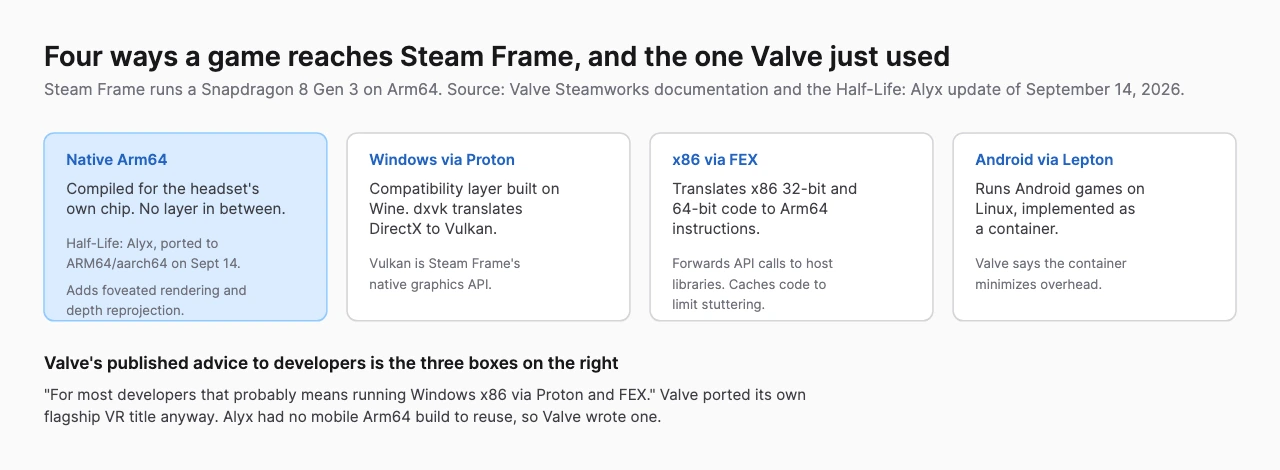
Valve then tells developers, plainly, not to build a second version. "We think customers are better off if a developer can focus on the one best version of their game, rather than making and maintaining many separate builds," the documentation reads, "especially if one build ends up as a second-class experience missing some testing or updates." It goes on: "For most developers that probably means running Windows x86 via Proton and FEX."
Valve then ported its own flagship VR title to Arm64. Both positions can be held at once, and the documentation allows for it, since it also says that a studio which has already built a mobile Arm64 version for other hardware should use it. But Alyx had no mobile version to reuse. Valve wrote one.
What Standalone Verified actually asks for
The port lands inside a program Valve runs for exactly this question. Steam Frame Standalone Verified is modeled on Steam Deck Verified, and Valve describes it as covering "the experience customers will have with the device out-of-the-box in standalone mode". Games get one of four badges: Verified, Playable, Unsupported or Unknown. Valve notes that the rating "will not affect whether your game is available to customers on Frame, but will affect how it is presented", and that it applies only to games running locally, never to a game streamed from a PC.
The performance bar is published. A VR title "must run at a minimum of 72 fps at 1728x1728 during normal play", and a VR game below 1440x1440 "will appear with an Unsupported badge". A 2D title needs 30 fps at 1280x720. Valve also recommends that developers submit motion vector and depth data "suitable for reprojection", which it says will let users "optionally run at higher refresh rates using improved reprojection techniques".
That recommendation is the other half of the Alyx patch note. Valve asked developers for depth suitable for reprojection, and the update Valve shipped for its own game adds depth reprojection. The public list of titles that have passed sits at Great on Frame, where Valve says the games listed "have been tested to be a great experience when played standalone on Steam Frame".
What Valve has not published
Three things a reader might reasonably expect, and none of them exist as a Valve document today.
There is no performance figure for Alyx on Steam Frame. Valve says the port runs standalone and that depth reprojection allows smooth gameplay at lower framerates, but publishes no frame rate, no resolution and no badge for the game in the announcement itself. The 72 fps floor above is the program's minimum, not a measurement of this title.
There is no statement about the rest of Valve's catalog. Nothing in the announcement says whether other Valve VR titles get the same treatment.
And the Standalone Verified list is rendered by script rather than served as text, so the number of titles on it was not counted for this report. Our Steam Frame launch report carries Valve's own figure of more than 100 titles, stated on the day of launch.
Related reading. The Steam Frame launch report covers the price, the reservation queue and what is in the box, and the XR headset comparison puts the Valve spec sheet beside Meta, Apple, Samsung and Pico.
Frequently Asked Questions (FAQ)
1. Does Half-Life: Alyx run without a PC now?
Yes, on Steam Frame. Valve's update of September 14, 2026 ported the game to ARM64/aarch64, which is the architecture of the Snapdragon 8 Gen 3 in the headset, and added support for standalone play. Playing it on any other headset still means streaming from a PC.
2. Is Half-Life: Alyx included with Steam Frame?
Yes. Valve states on the Steam Frame product page that the copy is redeemed in Settings after logging into the headset, that only one copy can be redeemed per device, and that an owner who already has Alyx in their library cannot redeem another.
3. What are foveated rendering and depth reprojection?
Foveated rendering draws the part of the image the eye is looking at in full detail and spends less on the rest, which relies on the headset tracking the eye. Reprojection generates intermediate frames from ones already drawn so motion stays smooth when the game cannot hit the display's refresh rate, and depth data makes that estimate more accurate. Valve added both to Alyx for standalone play.
4. Do other Steam games need an Arm port to run on Steam Frame?
No, and Valve advises against it for most studios. Its documentation says a Windows game runs through Proton, an Android game through the Lepton container and x86 code through FEX, which translates it to Arm64 instructions. Valve's stated preference is that developers ship one good build rather than maintain several.
5. What does a Standalone Verified badge mean?
That Valve tested the game running on the headset alone and it passed every criterion, including the default graphics configuration performing well, legible text and UI on the built-in display and a working default controller configuration. Playable means it works with manual user setup. Unsupported means it does not function on the headset. Unknown means the review has not been done.